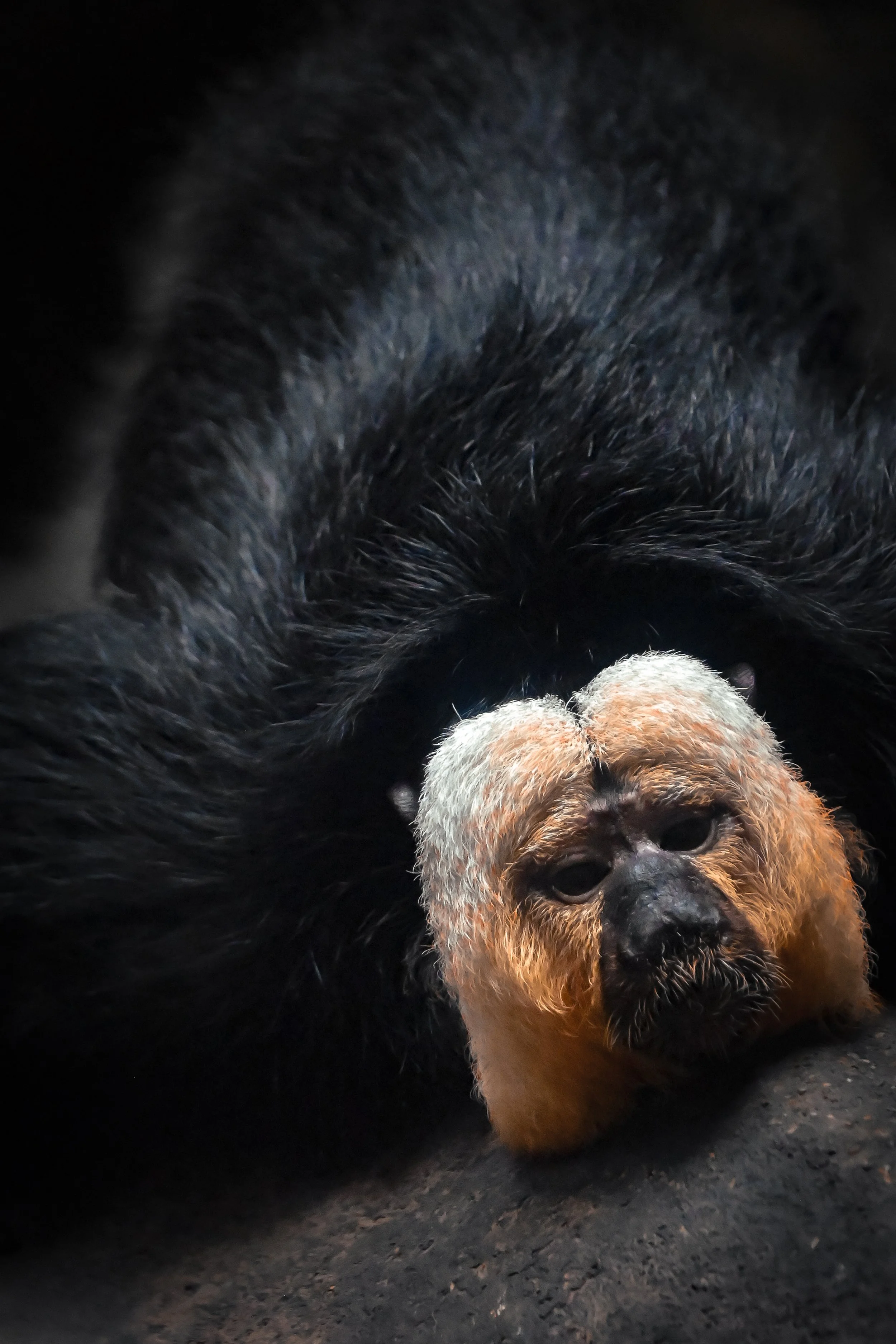
White-faced Saki
Conservation Status: Least Concern
Class: Mammalia
Order: Afrosoricida
Family: Cebidae
The white-faced saki is an agile monkey that is named after the male’s appearance, known for being all black except for a white and/or reddish face. Differing in appearance, its female counterpart can be characterized by its brown to brown-gray fur. This is known as sexual dimorphism and is common throughout the animal kingdom.
Populating northern parts of South America, the white-faced saki can be found in Brazil, French Guiana, Guyana, Suriname and Venezuela. The habitats in which they can be found are dense rain forests, savannas and marsh forests. In addition, they are considered arboreal, rarely descending to the forest floor.
White-faced sakis have a few ways of communicating including vocalizations, raising their hair, and jumping up and down on branches. The white-faced saki will usually emit a sharp and shrieking alarm call to maintain territorial boundaries.
The white-faced saki’s diet consists mostly of fruit, seeds, nuts, leaves, and insects and acts as a seed disperser for many plants. When their diet is low on certain minerals, they have been observed eating soil.
When it comes to grouping and socializing, white-faced sakis are a monogamous species sticking in pairs or small family groups. However, these smaller family groups can come together, sometimes, to form larger congregations.
On Conservation:
The white-faced saki happens to not be endangered in Brazil despite being hunted for food and captured as pets. However, their habitat, like many other animals, is threatened by destruction.